
PeopleSoft as a Product: Sustaining the Platform You've Built
Part 5 of the “Rethinking PeopleSoft” Series
Read part 1 here: Stop Supporting. Start Enabling: Why It’s Time to Rethink PeopleSoft as a Platform
Read part 2 here: What Actually Changes When PeopleSoft Becomes a Platform?
Read part 3 here: Customizing the Right Way: Building on the PeopleSoft Platform, Not Against It
Read Part 4 here: Your PeopleSoft Platform Roadmap: 10 Steps to Start the Shift
Sustaining Your Momentum
So, you’ve reimagined PeopleSoft. PeopleSoft is no longer just a legacy system to maintain, but a platform to build on. You’ve modernized infrastructure, automated the boring stuff, enabled your devs, and built observability into your environment.
Now what?
This final post is about sustaining the shift. Because moving to a platform mindset isn’t a one-time event, it’s an organizational commitment. It’s the difference between launching a product and actually running one. And yes, that’s the point: PeopleSoft isn’t just software you support, it’s a product you own.
Let’s discuss what’s required to keep that platform running strong.
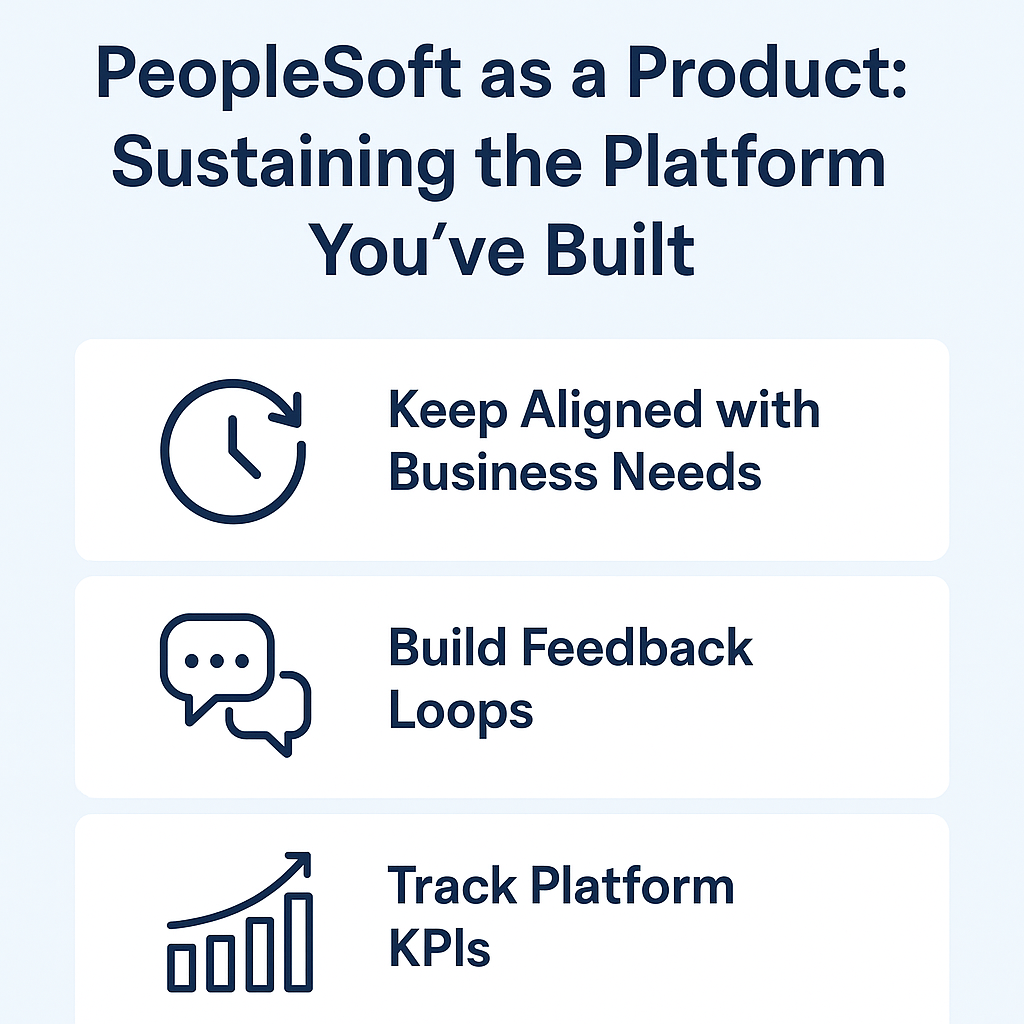
Keep Aligned with Evolving Business Needs
As business strategy shifts, so should your platform roadmap. A real product has a backlog, a feedback loop, and a delivery pipeline. Your PeopleSoft platform should, too.
- Revisit priorities quarterly: What’s coming down the line for HR? Finance? Student Systems? Are there new integrations or reporting needs that require enablement?
- Treat new requests like feature asks: Instead of reacting to each one-off ask, triage, estimate, and evaluate them like platform feature requests. This keeps the scope manageable and outcomes more strategic.
- Stay connected with leadership: The value of your platform team grows when it’s aligned with institutional goals. Make sure your roadmap evolves as the business evolves.
Build Feedback Loops with Developers and Functional Teams
The best platforms are built with their users, not just for them. Your developers and analysts should have a voice in how the platform grows.
- Run regular feedback sessions with devs, QA, and functional teams. What tools do they use? What’s still painful? What’s missing?
- Create a living dev portal with docs, examples, templates, and change logs. Update it consistently and make it the front door to your platform.
- Instrument your tools: If you’re delivering CLI tools, dashboards, or APIs, track usage. Know what’s being adopted and what isn’t.
Doing all of this transforms your team from sysadmins to internal product managers, responsible for delivering value that others want to use.
Define and Track Platform KPIs
You can’t sustain what you don’t measure. Define what success looks like. Remember to consider not only uptime, but also enablement, automation, and velocity.
Here are a few metrics worth tracking:
- Self-service actions per month (e.g., cache clears, refresh requests, log pulls)
- Time to deploy a customization (tracked across branches or tickets)
- Mean time to resolve platform-related issues
- Percentage of customizations using approved extension patterns
- Tool adoption rate (CLI usage, Git commits, dashboard hits)
- Automation coverage (e.g., patching, refresh, environment builds)
Make your platform measurable. Share wins. And use the data to focus your next round of improvements.
Final Thought: PeopleSoft as a Product
When you support an application, you wait for issues to arise and then fix them. However, when you operate a platform, you build the tools that keep others moving. Further, when you treat that platform like a product, you make it better every quarter. That’s what PeopleSoft can be. Not legacy. Not just stable, but strategic, extensible, visible, and enablement-focused.
Implementing this strategy is the long game. And your platform team is now the product team behind it.
That wraps the Rethinking PeopleSoft series, but hopefully, it’s just the beginning of how you operate, automate, and evolve your systems.