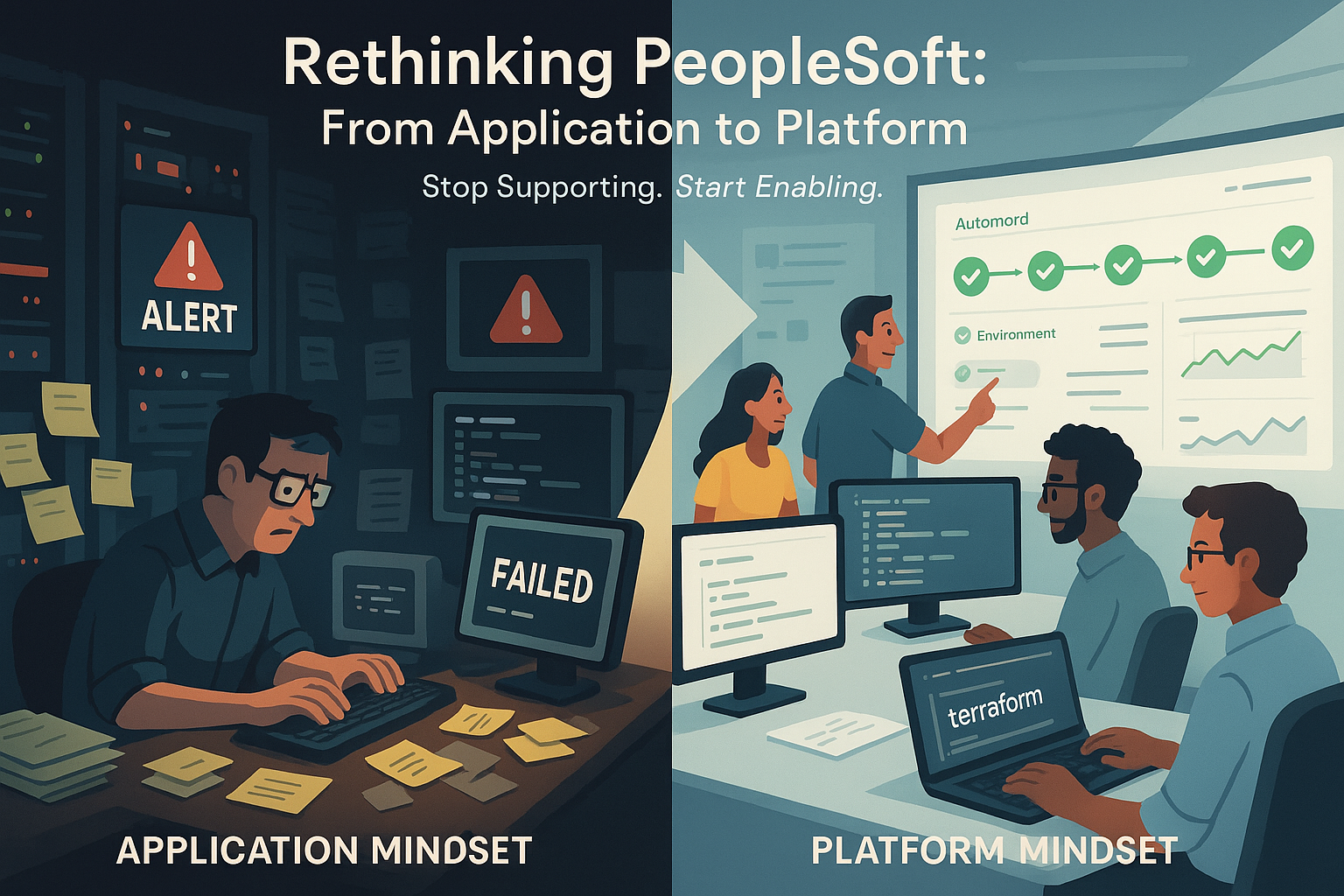
Rethinking PeopleSoft: What Actually Changes When PeopleSoft Becomes a Platform?
Part 2 of the “Rethinking PeopleSoft” Series
In Part 1, we discussed why it’s time to stop treating PeopleSoft as a legacy application and start approaching it as a platform. But let’s get practical. What changes when you make that shift?
This isn’t just about mindset. It impacts how your team operates, the tools you use, what you measure, and how your organization experiences PeopleSoft. Platform thinking reshapes roles, responsibilities, and expectations across the board.
Here’s what that shift looks like in practice.
Reactive Support vs. Proactive Enablement
Traditionally, PeopleSoft support teams have lived in maintenance mode, monitoring uptime, applying patches, troubleshooting outages, and reacting to break/fix issues. This work is essential, but it keeps your team trapped in a reactive cycle where progress only happens after something goes wrong.
Platform teams flip that model. Their focus is on enabling developers, testers, and analysts to move faster and safer by building systems, standards, and services. Instead of spending energy firefighting, they spend energy removing friction and creating reusable solutions that prevent issues before they happen.
Here’s how that shift looks in practice:
- Outages: Instead of waiting to respond, platform teams design systems with health checks, automated failover, and monitoring to prevent outages.
- Patching: Manual patching becomes automated pipelines that apply updates consistently across all environments.
- Environment Refreshes: Rather than one-off requests, refreshes become standardized and often self-service, letting QA or dev teams handle them without tickets.
- Monitoring: Basic uptime checks evolve into full observability—dashboards, alerts, logs, and metrics that highlight issues proactively.
- User & Developer Support: Tickets and ad hoc requests are replaced with tools, scripts, and documented processes that let teams help themselves safely and efficiently. The result is fewer repetitive tasks, less firefighting, and far more strategic value delivered to the business.
##What a Platform Team Owns This shift also redefines what your team is responsible for. In the application model, ownership is often infrastructure-heavy, encompassing servers, domains, and patches. In the platform model, your team owns:
- Infrastructure as Code (Terraform, DPKs)
- Automation pipelines (GitLab CI/CD for build/deploy/patch)
- Reusable templates and modules (for domain config, app setup, refresh jobs)
- Observability and alerting (Prometheus, Grafana, OpenTelemetry, Splunk)
- Developer onboarding and tooling (documentation, CLI tools, service APIs)
- Service standards (naming conventions, security patterns, versioning rules) You’re no longer just running a system; you’re running a platform product. That requires product thinking, internal customer support, and a clear sense of service ownership.
How This Impacts Your Org Chart and Skills Roadmap
A platform team doesn’t mean you fire all your sysadmins and hire DevOps unicorns. But it does mean you start shifting team roles in ways that align with modern engineering practices:
- Traditional sysadmins grow into platform engineers
- Manual tasks get automated, freeing time for architecture and tooling
- Team members take ownership over services, not just environments (e.g., someone owns Integration Broker, another owns observability, etc.)
- Soft skills, like documentation, internal consulting, and cross-functional collaboration, become just as critical as technical depth You also start hiring or training for new skills:
- Git and version control workflows
- Terraform, Chef/Ansible, and DPKs
- REST APIs and integration patterns
- Log aggregation, metrics, and trace pipelines
- Lightweight scripting to glue systems together The team starts acting like a product team, with a backlog, priorities, and internal users to serve.
Real-World Examples of the Shift
This isn’t theoretical. Here’s what these changes look like when put into action:
- 🔧 IaC for Environments
- Instead of manual PeopleSoft provisioning, you use Terraform + DPK to spin up environments in minutes. It’s version-controlled and repeatable.* 🔁 Service Ownership
- One team member becomes the go-to person for IB, monitoring queues, tuning throughput, and maintaining service mappings. Another owns cache tuning and WebLogic health. Everyone owns something.
- 🛠️ GitOps Workflows
- All DPK configuration changes and environment settings are stored in Git. Changes are tested, reviewed, and promoted via GitLab pipelines. You gain traceability and rollback.
- 🚀 Developer Self-Service Tools - Need to restart an app server? Clear cache? Pull logs? The platform team builds internal CLI tools or scripts to handle these tasks in a safe, audited, and consistent way, so developers and QA don’t have to wait on a ticket.
Final Thought
When PeopleSoft becomes a platform, your team isn’t just keeping systems alive; you’re building the systems that let others thrive. In the next post, we’ll explore how this shift changes the way you handle customizations. Spoiler alert: it’s not about saying “no” to changes, it’s about saying “yes, but here’s the safe, supported way to do it.”
Ready to stop patching and start enabling? You’re halfway there.